| Deals with | disease |
| Immunology | |
| Intended for | elementary school // middle school // high school // university |
| Available on | Windows |
| Cost | paid |
| Developed by |
Blendo Games

|
| Website at |
https://blendogames.itch.io/antibody-one
|
YOU ARE A CELL. Behold the majesty of life...
Enter the inner world of the human body. Explore the immune system, digestion system, and more.
Pilot different cell types. Fulfill their bodily functions. Simple controls: just WASD to move on keyboard, or gamepad left stick. This game is a short experience, roughly 10-20 minutes long. What happens when you eat a pizza...?
More information: Purchase for $1.00 USD or more. Must be downloaded and installed on a Windows computer.
| Expert Reviews By scientists and teachers |
14 / 15 | |
|---|---|---|
| Fun |
|
5 / 5 |
| Learning |
|
5 / 5 |
| Science |
|
4 / 5 |
| Player Reviews By everyone else (and you!) |
14 / 15 | |
|---|---|---|
| Fun |
|
5 / 5 |
| Learning |
|
5 / 5 |
| Science |
|
4 / 5 |
January 31, 2026

Melanie Stegman
I am a biochemist, making games to teach the invisible bits of cell biology.
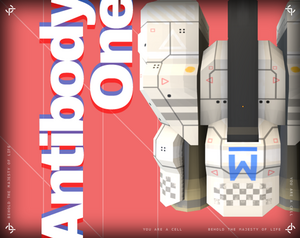
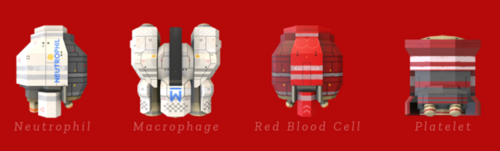
Antibody One is amazing. I loved it. I mean, look at the first screenshot of the “Playable Characters” of Antibody One. Left to right: Neutrophil, Macrophage, Red Blood Cell, and Platelet. How cool are these?? “Behold the Majesty of Life!” These spaceship versions of white blood cells bring joy to my heart.
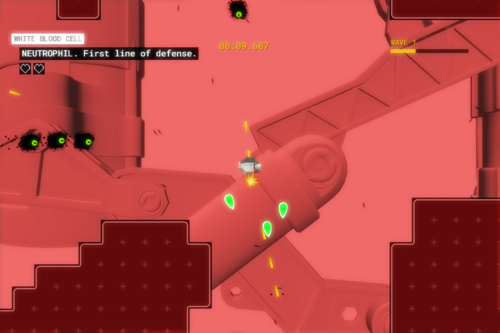
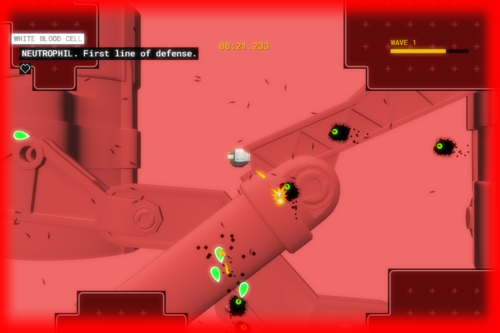
GAMEPLAY: In level 1, you pilot a Neutrophil that automatically aims and shoots at bacteria whenever they are in range. The bacteria are shooting back at your Neutrophil… You need to clear the field of invaders… so your challenge is to steer the Neutrophil into shooting range, while avoiding their missiles.
The gameplay feels like a tower defense game and a shoot ‘em up blended together. Antibody One is a great example of a unique game mechanic created by the exploration of the natural world. White Blood Cells are the best tower defense towers: always on guard, and able to act independently but also able to track the enemy and chase them down! The Tower Defense aspect of the game adds to the fun while nicely matching the true nature of phagocytes like the Neutrophil.
The game is a 15-minute experience, and only the first level has any proper game mechanic. But in that one level, Antibody One gracefully blends the reality of cellular survival into a game that makes you feel like you personally are discovering the whole idea of white blood cells, expertly fighting bacteria, and struggling against a relentless foe. This sweet combination of gameplay and biology is why I want to write this review…
After this first level, there is more cool stuff to see and learn. You play the role of different characters, including the Macrophage doing antigen presentation. Oddly enough, you also play the role of a piece of pizza, in the gastrointestinal tract! :) These levels are a fun, interactive textbook, i.e., they are not actual games. However, if you play to the last level, you get access to the endless version of level 1, which is worth it.
My final note about gameplay: It is difficult to create a game about biology without involving proteins. My game, Immune Defense, gave players agency by letting them choose which proteins to put on their cell at a given time. Basically, giving players proteins is the same as giving the players buttons to press that do things like “Make this cell able to eat E. coli” and “Make this cell able to eat Staph but not E. coli.” Proteins are a tool for creating some cool, strategic gameplay. However, with all the available protein buttons that the average cell has, it is a struggle to create a game that draws players in, lets them feel like they are in charge, and not overwhelmed. I love Blendo Games for jumping into the struggle! What an elegant Neutrophil game you have created!
SCIENCE: Antibody One captures the true spirit of the battle between our cells and bacteria. You, Neutrophil, are doomed to die. You get damaged by trying to defeat the bacteria, but you are Neutrophil! If you hung back to save yourself, who would you be then?
In real life, Neutrophils really do die in the struggle, but it is their own poison that kills them. Neutrophils do not shoot, they extend their blobby cell bodies out over the bacteria and “swallow” them. Once the bacteria are inside, the Neutrophil exposed them to oxidizing and nitrosylating chemicals as well as acid. These are the poisons that eventually kill the Neutrophil: These poisons break and make chemical bonds, causing DNA mutations and misshapen proteins that no longer do their jobs.
Neutrophils are selfless defenders. Blendo games gets the spirit of the conflict correct by making it so that the Neutrophil needs to be close to the bacteria to shoot them but that this close range makes damage almost impossible to avoid.
LEARNING: This Neutrophil vs bacteria battle is a great way to learn about cellular functions. Range, Detection, Identification, Weapons, Defense, Movement: All of these functions that the Neutrophil must perform are made clear to players in Antibody One. The player is already wondering: How does this work in real life?
I have watched many hundreds of people play Immune Defense and at least half of them turn and ask, “Is this how it happens in real life?” Additionally, my data shows that students who played Immune Defense were more confident about science diagrams that looked like the game. Players were more confident than their classmates who did not play and more confident about images styled like the game than they were about other images of the same cells.
So if you want students to approach your first lesson about cells with curiosity and confidence, have them play Antibody One first. Then, the first time you show your students anything about WBC or pathogens, use images from the game and put them side by side with real-life images.
Look at your learning objectives and think about the processes that occur in the game play that are realted to your objectives. I expect you’ll be including: the different types of WBC: Some WBC can track and kill pathogens; some can activate other WBC; some can present bacterial proteins to other WBC to prepare them to fight a particular pathogen…
These basic WBC functions will be in the students’ minds because they did the tracking themselves as the Neutrophil. They did the eating of dead pathogen pieces themselves as the Macrophage. They did something with those dead pieces… they might not remember well what exactly. But your students will be familiar with the process of tracking pathogens, killing them (though the mechanics of phagocytosis will need to be taught), collecting leftover parts, and presenting the stray parts to T Cells for a more powerful and focused response.
Play through Antibody One, or whatever Science Game you want to use, and list the mechanics: the stuff players need to do. List the processes that the players go through. Scaffold your lesson on their experiences in the game.
You will be able to start with the question “How do Neutrophils track bacteria?” “How do neutrophils kill?” “How do they know what to kill?” The students' minds are prepared. If the students do not ask, you can show them a screenshot of level 1 and ask them these questions.
I believe that after playing Antibody One, you will be able to introduce the proteins—the tools—that the cells use. Tools that track, identify and kill bacteria. I hope you write back and tell me how it goes.
Fun rating: 5 out of 5
Learning rating: 5 out of 5
Science rating: 4 out of 5
Total:
14 / 15
This review has 0 comments.