| Deals with | math // physics // science // zoology |
| engineering design, connections between shape and physical function, testing and iteration | |
| Intended for | elementary school |
| Available on | Web // Android // iOS |
| Cost | free |
| Developed by |
Smithsonian Science Education Center

|
| Website at |
https://ssec.si.edu/tamis-tower
|
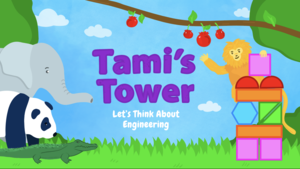
It’s lunch time and Tami, the golden lion tamarin, is hungry! Help Tami reach the delicious fruit by building a tower. But watch out! Other animals can cause Tami’s tower to topple over.
From the Smithsonian Science Education Center, Tami’s Tower: Let’s Think About Engineering is an educational engineering design game that will help teach your student how to design a solution to a problem using basic engineering design principles.
Educational features: • Aligned to educational science standards for kindergarten through second grade • Designed for emergent readers • Grounded in educational psychology research • Metacognitive prompts provide students an opportunity to monitor and assess their own confidence • Teachers can assess student responses to metacognitive prompts through an in-game summary screen • In-game tutorial to teach students how to play • Introduces students to engineering design principles • Students will learn how the shape of an object can help it function as needed to solve a problem • Students can reflect on previous attempts to improve design • Students can design a level in Sandbox mode • Designed to be used in the classroom or at home
| Expert Reviews By scientists and teachers |
— | |
|---|---|---|
|
We don't have any expert reviews yet for Tami's Tower: Let's Think About Engineering. Are you a scientist who has played this game or a teacher who has used it in the classroom? Contact us about writing an expert review today. |
||
| Player Reviews By everyone else (and you!) |
10 / 15 | |
|---|---|---|
| Fun |
|
3 / 5 |
| Learning |
|
3 / 5 |
| Science |
|
4 / 5 |
February 23, 2026

ElizKath
Player
I purposely chose a game that wasn’t for me as an audience, but a game I could keep on my phone to help me entertain the kids in my life. While it is made for a much younger audience, it still made me want to move on to the next level and continue playing. It seems basic enough for different age groups, but it might not be as fun for someone who is constantly failing and having to try again. There is a hint feature, but I wish it was a little bit more accommodating. It only helps as a hint if you can read and understand English. I would recommend instead suggesting pictures of the first shape to put down or how the shape should be rotated.
You start out with easy builds and less disturbance/shake and build up to more complicated builds with an ability to rotate shapes to stack in the most efficient way. You don’t need to know science in terms of physics to play the game, but after the first few basic levels you do need to have a grasp on how best to configure and stack complicated shapes. After a few levels, the player learns to make better, sturdier foundations with the shapes so they can be built higher or stand the vibrations caused by heavier animal movements.
In addition to experimenting with shapes and physics, after each attempt to build a tower sturdy enough for Tami to reach the fruit during a ground shake, I had to rate my confidence, choosing yes, maybe, or no, about whether I thought it would hold. This made me think and evaluate my own work. If I failed, I was encouraged to try again and there was an outline of what I tried before to remind me to not try the exact same configuration. You can also access a summary where you see each level and what your success was, along with what you rated your own approach before the experiment took place. This children’s game had more elements of analysis and conclusion than I would have guessed.
Fun rating: 3 out of 5
Learning rating: 3 out of 5
Science rating: 4 out of 5
Total:
10 / 15
This review has 0 comments.